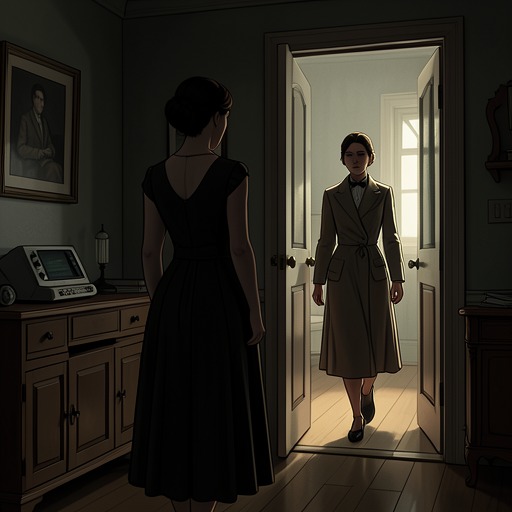
Pepe el Romano
The House of Bernarda AlbaPepe el Romano never appears on stage, yet the prospect of his marriage to Angustias and his secret relationship with Adela shape the action inside Bernarda Alba’s house. He is presented as a young man whose courtship is entangled with Angustias’s inheritance, while his nighttime visits reveal the difference between the engagement visible to the family and the desire kept from it. When Bernarda pursues him with a gun, he escapes; the false report that he is dead helps precipitate Adela’s suicide, after which Bernarda orders the family to conceal the truth about her daughter.
Identity and Introduction
Pepe is a local young man, fourteen years younger than Angustias, whose impending marriage is first announced to the household by Magdalena. At twenty-five, he is described as the best-looking man for miles around. The sisters immediately question why he would choose Angustias, who is thirty-nine, rather than one of the younger daughters; Amelia observes that Angustias is the only rich person in the house and connects Pepe’s courtship to the division of their father’s estate. Their suspicions establish money as part of the marriage’s circumstances, without resolving what Pepe himself wants from the match.
The play’s background also associates the name with a real person. The commentary identifies José Benavides, known as Pepico el de Roma because he came from Romilla or Roma la Chica, as the source for Pepe el Romano. It notes that the surname Benavides was transferred in the play to Bernarda’s husband, Antonio María Benavides. This connection belongs to the work’s grounding in local reality; the dramatic character remains defined chiefly through what the household hears, infers, and fears about him.
Courtship and the Household’s Inferences
Pepe’s engagement gives Angustias a path toward marriage, but the sisters’ attention soon turns to the hours at which he leaves her window. In the inner room where Angustias, Martirio, Magdalena, and Amelia sew, Amelia recalls that he left Angustias’s window at half-past one. Poncia says she heard someone leaving at about four. Later, Angustias says Pepe has been leaving at one o’clock for more than a week, while Martirio also says she heard him depart at four. The differing accounts and repeated late-night departures make the visits a matter of household scrutiny rather than a settled, openly discussed courtship.
The unease deepens when Poncia reports that Pepe has been seen talking to Angustias at half-past four in the morning. Angustias denies the report, and Bernarda responds by asserting authority rather than investigating what the conflicting accounts mean. On another evening Bernarda tells the household that Pepe will not visit because he has gone on a journey. These details keep his movements at the center of the women’s conversations while leaving him himself absent from the stage and from direct explanation.
Angustias’s engagement is also shadowed by her stepfather’s will. Antonio María Benavides has left her substantially more money than his natural daughters, a difference that Magdalena resents and Amelia explicitly associates with Pepe’s interest in the wealthy heiress. The commentary raises, without answering, a further possibility: whether Antonio María Benavides’s unequal bequest indicates a closer relationship with Angustias, and whether Bernarda suspects it. That uncertainty reinforces the household’s pattern of hidden matters, but it does not establish a motive for Pepe beyond the sisters’ speculation.
Portrait, Rivalry, and Secret Relationship
The engagement becomes a focus of conflict when Angustias discovers that Pepe’s portrait, which she had kept under her pillow, is missing. Bernarda questions the daughters and orders Poncia to search their rooms. The portrait is found between the sheets of Martirio’s bed. Bernarda strikes Martirio with her stick, and the discovery intensifies the resentments among the sisters. The image makes Pepe a literal object of possession and dispute: Angustias keeps it as her fiancé’s portrait, while Martirio has secretly taken it.
Poncia recognizes that Adela is fascinated by Pepe and urges her to put aside her desire. Adela rejects the advice and insists that nobody can stop her. Her conflict with Martirio grows sharper as the evidence of the nighttime visits accumulates. In their final confrontation, Adela tells Martirio that Martirio knows Pepe does not love Angustias and knows that he loves Adela. Martirio acknowledges both claims. The scene makes explicit what the earlier reports and suspicions had left unsettled: Pepe is secretly involved with Adela, while Martirio also loves him and opposes her sister.
The affair intersects with the village’s severe judgement of women’s sexuality. During the disturbance over an unmarried young woman who has given birth and tried to dispose of her baby, Bernarda calls for the woman’s death; Adela clutches her stomach. The gesture suggests that the public punishment of an unmarried mother bears directly on Adela’s situation, though it does not by itself establish that she is pregnant. The scene places her secret relationship with Pepe within a social order that threatens women with disgrace and violence while permitting men greater sexual freedom.
Final Confrontation and Aftermath
In the final confrontation, Adela declares her relationship to Pepe in front of Angustias and tells her to go outside and tell him that she knows. She says that he is waiting outside. Bernarda calls for the gun and rushes out in pursuit of him. A shot is heard, and Martirio tells Adela that Pepe is dead. Believing this report, Adela runs into another room and locks the door. Martirio then reveals that Pepe has escaped and ridden away. Bernarda acknowledges that she missed, but Pepe’s survival comes too late to undo Adela’s response to the false news.
When the locked door is opened, Poncia’s actions and words make clear that Adela has hanged herself. Bernarda immediately commands that her body be cut down, that the story be told that Adela died a virgin, and that the household enter another period of mourning. Pepe is therefore not present for the death or its concealment, but his escape, Martirio’s false report, and the secret relationship are central to the chain of events that ends in Adela’s death. Bernarda’s cover-up restores the family’s public claim to honour by suppressing the truth of the relationship, while the play’s ending leaves Pepe alive and absent.
Dramatic and Social Significance
Pepe functions as the unseen center of a conflict in which marriage is both an economic arrangement and a field of desire. Angustias’s inheritance makes her engagement suspicious to her sisters; the portrait turns that engagement into an object of rivalry; and the late-night departures make the official courtship appear incomplete or divided. The play does not give Pepe a direct voice with which to clarify his intentions. Instead, his significance emerges through the women’s observations, claims, concealments, and competing attachments.
That dramatic absence also makes his relationships inseparable from the rules governing the household. Angustias is advised not to question her fiancé or show distress, while Adela’s claim to choose him for herself is set against Bernarda’s authority and the village’s sexual double standard. Martirio’s love and jealousy further complicate the rivalry: she recognizes Pepe’s attachment to Adela, yet her false claim that he has died triggers the final catastrophe. Pepe’s role is thus less that of a fully present romantic protagonist than the catalyst through whom the play exposes the pressures of inheritance, female confinement, secrecy, and family reputation.